
Hey, look at that! The New York Times just ran a breathless interview with an AI slopmeister who confesses to using generative AI to flood the Kindle store and drum up sales. She earned six figures last year from doing so, which is kind of a paltry take when you consider she had to publish over 200 different novels to get that level of return. She successfully matched the output of a major publishing giant and for her “trouble” was rewarded with less than 1% of their profits. It also feels kinda sorta fraudulent when you realize that, in order to reach that level, she had to take steps to avoid readers finding out she used AI. Why?
Ms. Hart doesn’t disclose her use of A.I., because there’s still a strong stigma around the technology, she said. Coral Hart is one of her early, now retired pseudonyms, and it’s the name she uses to teach A.I.-assisted writing; she requested anonymity because she still uses her real name for some publishing and coaching projects. She fears that revealing her A.I. use would damage her business for that work.
But, hey, at least she’s pumping out great work, right? Or at least serviceable?
Some programs refused to write explicit content, which violated their policies. Others, like Grok and NovelAI, produced graphic sex scenes, but the consummation often lacked emotional nuance, and felt rushed and mechanical. Claude delivered the most elegant prose, but was terrible at sexy banter.
“You are going to get hammering hearts and thumping chests and stupid stuff,” said Ms. Hart, who lives in Cape Town in South Africa. “At the end of every sex scene, everyone will end up tangled in the sheets.”
Chatbots were also bad at building sexual tension — the slow-burn, will-they-or-won’t-they plotlines that romance readers crave. When told to craft a love scene, the bots usually jumped straight to the obvious narrative climax.
At this point you might be wondering, as I was, why she has “become an A.I. evangelist.” She has to crank out an ungodly amount of books to earn the same amount as a midlist author who produces 2-3 books a year from their own brain, she has to hide how she does her writing for fear it will tank her sales, and the product that it produces isn’t up to her usual standards of work. Even before you factor in things like data centers polluting the environment and profiting from the plagiarism of every other author who has ever worked, it really seems like a horrible way to make a living.
You know what you could do instead? Make soap 📺. It’s super-easy and cheap to get started, it’s a valuable skill that you can master over time, the knowledge is transferable to other tasks, and people actually need it so a booth at your local farmer’s market can do a brisk trade if you find a nice scent blend. A lot of people don’t even bother to double-check your ingredients because it’s freakin’ homemade soap. And if you master your marketing and have a good label, you can sell each bar of soap at a much higher price than you get for your AI slop on the Kindle store.
And, as an added benefit, if you charge people for $300 for a soapmaking workshop, nobody will accuse you of being a bottom-feeding grifter.

Because that’s been the real moneymaker for Coral Hart. She runs workshops that teach people how to launch their “book business” by using AI. A month of mentorship that she promises will land you in the Kindle store with three books published immediately will set you back around 300 USD. I don’t really have any idea whether you’re actually being mentored by her or by a chatbot instructed to pretend to be her.
But let’s get back to why anybody would choose to do this. Especially anybody who had previously been a Harlequin-published author so we know she’s actually capable of producing publishable work that sells without using an AI crutch.
(Or, at least, she could before she started relying on ANTHROP\C’s Claude to write her books. It turns out that AI-induced skill decay is a very real thing, so at this point in her career — who knows‽)
And the answer to the question of “Why?” is the thing that provoked a moment of absolute artistic rage in my soul.
The way Ms. Hart sees it, romance writers must either embrace artificial intelligence, or get left behind.
“If I can generate a book in a day, and you need six months to write a book, who’s going to win the race?” she said.
Some variation on this argument is heard in any artistic endeavor where AI is currently encroaching. “I can produce new work faster than you, so I win.”
But that’s not an artistic mindset. That’s a corporate mindset.
That’s not to say that writers never find themselves in rivalry with each other. You can find lots of stories about writers who were constantly striving to outdo each other. And for lots of reasons. Writers, film directors, musicians, painters, photographers — there are tons of rivals out there in every field.
But their rivalries tend to stem from reasons beyond base, monetary competition. They might be rivals because they disagree on the creative process (see the majority of comic artists and Jim Davis). Others have very personal beef with each other because of disagreements on basic morality (see Patton Oswalt and Jeff Dunham). But the vast majority of these competitions are the somewhat-friendly rivalry that comes from sharpening your skills against each other time and time again (see the triad of George Lucas, Steven Spielberg, and John Milius; see also 90% of pokémon trainers).
Because — and this is the real secret that artists in every medium don’t want to get out — we’re not in competition with each other.

I know this is a major shock to you — but, in general, the market is supposed to be big enough for all of us. Stephen King doesn’t have to worry that Dean Koontz got a new book out before he did because they’re not in competition. Same with Taylor Swift and Ariana Grande releasing an album, and even Kevin Smith and Tim Burton releasing movies (Tim Burton just hates Smith because he made a joke about Planet of the Apes once).
It’s the companies that are in competition. And if they were able to flood the field with shit to stop the other companies from being able to put anything out, they absolutely would. In fact, in the film industry, regulations had to be put in place to keep studios from finding ways to flood movie theaters with product for the express purpose of keeping their competitors out.
When you call yourself a writer (or a filmmaker or a musician or a…) but your key concern is flooding the marketplace to keep everyone else out, you’re not an artist. When your sole purpose is clogging the marketplace to the point that somebody will — even by accident — wind up buying your thing instead of somebody else’s, you’re not a creator.
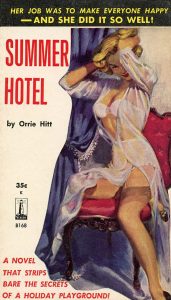
Let’s be blunt about this. If you see it as a race to get into the market with the most content the fastest, you are not a hack. I actually have a lot of respect for hacks — because, while they are often producing as fast as possible to make a living, they are doing so with skill and craft. From 1953 to 1970, Orrie Hitt published 150 novels — 144 of those were published prior to 1964. He wrote primarily detective novels and unadulterated smut (often combined), and at the height of his career he was pounding out a book every two weeks fueled by iced coffee and cigarettes.
He wrote at this pace because he was writing work-for-hire and received a flat fee for every manuscript he sent in, and he had daughters who wanted to go to college. Daddy’s smut career paid 100% of their college degrees.
And, if you’ve ever read any of Hitt’s work, then you know that he was ridiculously good at writing. The legacy of his work has earned him the nickname “The Shabby Shakespeare.” In another lifetime, he might have been another Phillip Marlowe or Dashell Hammett instead of laboring away in the Men’s Sweats.
But one thing he absolutely did not do was flood the market with shit because he saw a small pool of money and he wanted to suck it all up with the minimum amount of effort.
That’s the territory of the AI slopmeister. It’s seeing that the companies are trying to generate content while paying out an ever-dwindling pool of money, and deciding, “I can take all of that for myself.”
You ain’t smooth. You ain’t clever. You ain’t even a hack.
You have decided to kill art and craft and human communication just to claim a few pennies for yourself.
You’re a cold-blooded capitalist of the absolute scummiest kind.
Featured Image by Quân Lê Quốc from Pixabay